
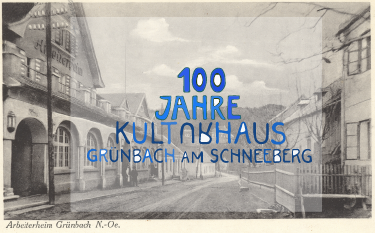
100 Years - Arbeiterheim : a building with history
After the first workers' home of the former Habsburg monarchy was opened in Vienna on October 23, 1896, the initiative of miners made it possible to build a home for workers in Grünbach am Schneeberg. The "Workers' Home" (Arbeiterheim) association was founded on August 26, 1920 and the workers' home was opened in December 1924. After four years of construction, the plans of architect Henry G. Jäger were realized by the construction company Arnoldi with the help of the miners.
In addition to the political aspects of the workers' movement in Grünbach, the workers' home was also a place for social democratic educational work. The wide-ranging workers' culture, with its associations of singers, theater players, musicians, chess players, children's friends, Red Falcons, workers' gymnasts and nature lovers found a new home in the workers' home in Grünbach.
Major political disputes, such as the great miners' strike of 1932/33, also took place in the workers' home. The connection between the workers' home and the coal mine was of great importance. Whether it was a strike demonstration, May Day celebrations or St. Barbara's Day celebrations, people always marched away from the coal mine and the final rallies took place in the workers' home.
From 1934 to 1938, the workers' home was confiscated by the Ständestaat and in March 1938 by the German Labor Front. After the end of the war in 1945, the Workers' Home was placed under Soviet administration (USIA) and returned to the Workers' Home Association in 1948 (restitution agreement).
Until the end of the 1970s, the Arbeiterheim was the cultural center of Grünbach. Almost all events (culture, balls, etc.) took place in this building. Unfortunately, the cinema had to be closed on June 30, 1973 due to a decline in attendance. The last event was in March 1987 (KPÖ masked ball).
The workers' home stood empty for 20 years and fell into disrepair. In 2008, Bea von Schrader and her cultural association "Urhof20" managed to save the building from decay. Her initiative not only preserved this historic building for Grünbach am Schneeberg, but also made an important contribution to Grünbach's cultural life through various events.
Text by:
Dr. Georg Reisner
&
Rudolf Hussajenoff
freely translated in deepl.com